Friday, June 28, 2013

Joy


“If you do away with the yoke of oppression, with the pointing finger and malicious talk,
and if you spend yourselves in behalf of the hungry and satisfy the needs of the oppressed, then your light will rise in the darkness, and your night will become like the noonday.”    
Isaiah 58:9b-11 (NIV)

The revelation of God is whole and pulls our lives together. The signposts of God are clear and point out the right road. The life-maps of God are right, showing the way to joy. The directions of God are plain and easy on the eyes. God’s reputation is twenty-four-carat gold, with a lifetime guarantee. The decisions of God are accurate down to the nth degree.   
Psalm 19:7-9  (The Message)

On June 20th (What Makes Us Happy?) and 21st, 2013 (Why Those Who Feel They Have Less Give More), Paul Solman on the PBS Newshour addressed the growing economic inequality in our society and the associated effects.  He reviews the findings of the Greater Good Science Center at the University of California, Berkley.   As you might guess, the questions and the answers are controversial!  

“The U.S. is kind of a notable case in the sense that in the last 35 years, as GDP has grown, we actually haven't seen our average happiness level go up.”  Christine Carter on What Makes Us Happy?

“There are a lot of new data that show if you're generous, and charitable and altruistic, you'll live longer; you'll feel more fulfilled;”  Dacher Keltner on Why Those Who Feel They Have Less Give More.

 I have come to come to two conclusions:
(1)  Even without experimental evidence, the ancient psalmist and the prophet Isaiah would agree that one of those “signposts” leading to a  joyful life is the virtue of charity.

(2) The scientific approach to hard questions of “purpose and place” may be good news to those who search for joy.   What a wonderful surprise when science is usually seen as antithetical to the search for meaning.


Marvin


References:

Photo by Elizabeth Hage

Hage, M. L. (2012). Burdens and Benefits. 

Hage, M. L. (2013). The Poor. 

Thursday, June 13, 2013

Healing Tools


Jesus now called the Twelve and gave them authority and power to deal with all the demons and cure diseases. He commissioned them to preach the news of God’s kingdom and heal the sick. He said, “Don’t load yourselves up with equipment. Keep it simple; you are the equipment.                           Luke 9:1-3 (The Message)

In her recent book, Dirt Work, Christine Byl describes the sacred (my word) work of a traildog where tools and vocation meet.  She works in complicated and mysterious places.  She and her husband worked at Glacier National Park and now in Alaska.  She reports on a life of physical labor.  It is an earthy tale!

For me, the connection with her story was the use of tools.   Specifically, tools, both simple and complex have been at the heart of my profession.  When I first received that black bag and within it the first stethoscope, I entered a world where healing tools would be a part of my life.   They required dedication to learn the secrets they would reveal.

The tool most taken for granted were my hands.   The best expression of the power of hands was the comment I heard about a retired surgeon who was said to have “kind hands”.  That ability to transmit care is the essence of a healing tool.  For his colleagues, the skill and efficiency of his hands were impressive even though the patient only felt his touch before and after the surgery.  

The many tools we use should not be the focus of our work.   What is sacred and mysterious is how the tools bring healing by those who learn to use them.

Marvin

References

Byl, C. (2013). Dirt Work: An Education in the Woods. Beacon Press. 
Gawande, A. (2011). Personal best. The New Yorker

Wednesday, May 29, 2013

Global Health

For God so loved the world....John 3:16a (KJV)

President Obama in his speech on national security (5/23/2013) argues for policies that reaffirm our pursuit of justice and a just war in the face of terrorism.  Brain McLaren in his recent book, argues for a stronger but less hostile Christian response to other world religions.  Paul Farmer addresses the global health issues in his book, To Repair the World.   The voices are mixed but the message is clear that healing is the central idea and response to suffering and violence.

The meaning of healing has many facets but begins after seeing and defining the distress and disease.  We need to see the underlying injustice and inequity and respond in clear ways of peace and courage.  Education is one such response that changes and is empowering, but education alone does not necessarily bring purpose to lives.  Many times the purpose is found in a deep longing to make a difference in the lives of others.

For Christians, we look to a model that identifies another reality and purpose,  That reality brings aid, education and understanding to the world out of the Love that has been given to us as a gift.  Love becomes a “verb” that results in the courageous acts that overcome the violence and evil in the world.  Love is at the center of our faith.  Sometimes we just say “God’s Grace”!

Marvin


References:


McLaren, B. D. (2012). Why Did Jesus, Moses, the Buddha, and Mohammed Cross the Road?: Christian Identity in a Multi-Faith World. Jericho Books.

Farmer, P. (2013). To Repair the World: Paul Farmer Speaks to the Next Generation. University of California Press. 

Previous Related Posts:


Thursday, May 9, 2013

Healing Music


We recognize the power of music to heal even when we don’t completely understand the mechanism.   One of my first exposures to the healing found in music was the work of Stevie Ray Vaughn and his "Caught in the Crossfire”. 

Recently, I heard a new CD by Jim Morgan, Hymnagination.   It is compilation of hymns that bring together some older gospel hymns with common themes.  When you listen to these piano solos, you will hear the familiar tunes with a new ear.  Previously, I mentioned a magnificent collection by Jonathan Elias, The Prayer Cycle. (Hope)  What is common to all is a theme built around common beliefs translated into music in a new and creative way.

In the broadcast “On Being”(5/2/2013), we learn about the neuroscience of creativity.  A short summary is that we need to “slow down” to be able to put the “pieces together” in new ways.  These insights help us put in context the new experiences and directions of our lives.

What I have learned is that the deepest language of healing is found within music that captures those beliefs and experiences and leads to new directions in our lives.  Healing music has a resonance with our deep knowledge and pain.   This resonance is what breaks and “names the silences”.  

Marvin


References

Hage, M. L., Tetel-Hanks, J., Bushyhead, A. (1994). Caught in the Crossfire. Duke University Medical Center

Previous Post: Hope  June 18, 2012

McGregor BA, Antoni MH. Psychological intervention and health outcomes among women treated for breast cancer: a review of stress pathways and biological mediators.  Brain, Behavior, & Immunity.  23(2):159-66, 2009 Feb.

Hauerwas, Stanley  Naming the Silences, Wm. B. Eerdmans, 1990


Sunday, April 21, 2013

Forgiveness

Burundi

And forgive us our debts, as we forgive our debtors  Matthew 6:12

Then said Jesus, Father, forgive them; for they know not what they do. And they parted his raiment, and cast lots.   Luke 23:24

There are amazing stories of forgiveness in the face of horrific violence.  That is what we hear from those who live out these stories in places like Rwanda and Burundi.  I had the opportunity to meet Freddy Tuyizere who works for Youth for Christ International.   His work with his staff builds homes and communities for those who are the survivors of genocide - www.burundiyfc.org (Check out this site).

We are taught to pray the “Lord’s Prayer” that requires that we “forgive our debtors” as a daily prescription!  This prescription is one that leads to healing.   The prescription is counter-cultural in our violent world where we look for compensation and retribution.  We want to believe that justice will heal the wounds.  

We believe it is significant that from the Cross is another time we hear the mandate to forgive.  Help us to see our crosses through the lens of forgiveness and understand that the Cross is the source for all our healing.  

Thanks be to God for the living witness of Freddy Tuyizere.

Marvin


Related Posts
Restoration - March 14, 2013
Suffering - February 11, 2013
Healing Presence - January 3, 2013
Healing and Violence  - December 16, 2012
God's Grace - October 30, 2012


Sunday, April 7, 2013

Selah

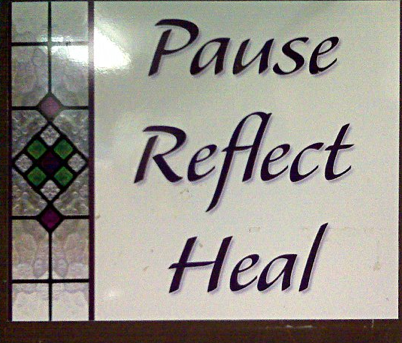
 “Patient Room Reminder”
Johnson City Medical Center, Johnson City, Tennessee

I cried unto the Lord with my voice, and he heard me out of his holy hill. Selah   
Psalm 3:4 King James Version

Richard Lischer’s new book, Stations of the Heart: Parting with a Son, describes the lived suffering and healing in a family and community of faith.  He invites all of us to be part of the conversation.  It is a conversation about crosses and the heart of the Christian faith.

The narrative by Richard Lischer is important because as Christians we are all part of the mystery of the story he tells of courage, hope and faith.  It is a unique story of a father’s love and loss.   It is a long story without short-cuts, easy answers or generalizations.  It is difficult lesson!

“Selah” is one of those ancient prescriptions that provides some direction.  It can be translated as “Pause, Reflect, Heal”.   It is a reminder to all who enter the suffering stories of our lives.  It is a beautiful word!

Thanks be to God for this awe-inspiring story of loss and the challenge of what it means to be a healing agent.  

Marvin


References:

Lischer, Richard (2013-04-02). Stations of the Heart: Parting with a Son Knopf Doubleday Publishing Group. Kindle Edition.


Saturday, March 23, 2013

The Poor

Poverty Map

Looking at his disciples, he said:
“Blessed are you who are poor,
    for yours is the kingdom of God."
Luke 6:20 (NIV)

For you know the grace of our Lord Jesus Christ, 
that though he was rich, yet for your sake he became poor, 
so that you through his poverty might become rich.
2 Corinthians 8:9 (NIV)

The naming of Pope Francis (3/13/13), a Jesuit from the global south, was a remarkable act with and because of his focus on the poor.  Could it be that the poor will be a “blessing” and a healing agent?   Could it be that the mission of the church to the poor will be a healing moment of a God who is at work in the world?  Will Pope Francis be a “healing agent”?

There is no question that the poor have generated concern and debate within and outside the church.  What seems missing in the conversation is whether or not we are “with the poor”.  Being present with them is the Christ-like response and His mandate.

For healthcare and specifically global healthcare, let us affirm that we are with them where God is at work.   Let us join with the church universal in being “where God lives”!  Let us pray for wisdom in how we respond in both our hearts and our acts as partners in the Kingdom of God.  Help us to see our poverty and become rich with the blessings of the poor.   

Marvin

References:


Debates about the Poor:
TED Talks - Hans Rosling & Esther Duflo
When Helping Hurts: How to Alleviate Poverty Without Hurting the Poor...and Yourself by Steve Corbett, Brian Fikkert

Selected Posts: 
4/23/12 - Rx - Ubuntu
1/23/11 - Peace from Above