Thursday, May 9, 2013

Healing Music


We recognize the power of music to heal even when we don’t completely understand the mechanism.   One of my first exposures to the healing found in music was the work of Stevie Ray Vaughn and his "Caught in the Crossfire”. 

Recently, I heard a new CD by Jim Morgan, Hymnagination.   It is compilation of hymns that bring together some older gospel hymns with common themes.  When you listen to these piano solos, you will hear the familiar tunes with a new ear.  Previously, I mentioned a magnificent collection by Jonathan Elias, The Prayer Cycle. (Hope)  What is common to all is a theme built around common beliefs translated into music in a new and creative way.

In the broadcast “On Being”(5/2/2013), we learn about the neuroscience of creativity.  A short summary is that we need to “slow down” to be able to put the “pieces together” in new ways.  These insights help us put in context the new experiences and directions of our lives.

What I have learned is that the deepest language of healing is found within music that captures those beliefs and experiences and leads to new directions in our lives.  Healing music has a resonance with our deep knowledge and pain.   This resonance is what breaks and “names the silences”.  

Marvin


References

Hage, M. L., Tetel-Hanks, J., Bushyhead, A. (1994). Caught in the Crossfire. Duke University Medical Center

Previous Post: Hope  June 18, 2012

McGregor BA, Antoni MH. Psychological intervention and health outcomes among women treated for breast cancer: a review of stress pathways and biological mediators.  Brain, Behavior, & Immunity.  23(2):159-66, 2009 Feb.

Hauerwas, Stanley  Naming the Silences, Wm. B. Eerdmans, 1990


Sunday, April 21, 2013

Forgiveness

Burundi

And forgive us our debts, as we forgive our debtors  Matthew 6:12

Then said Jesus, Father, forgive them; for they know not what they do. And they parted his raiment, and cast lots.   Luke 23:24

There are amazing stories of forgiveness in the face of horrific violence.  That is what we hear from those who live out these stories in places like Rwanda and Burundi.  I had the opportunity to meet Freddy Tuyizere who works for Youth for Christ International.   His work with his staff builds homes and communities for those who are the survivors of genocide - www.burundiyfc.org (Check out this site).

We are taught to pray the “Lord’s Prayer” that requires that we “forgive our debtors” as a daily prescription!  This prescription is one that leads to healing.   The prescription is counter-cultural in our violent world where we look for compensation and retribution.  We want to believe that justice will heal the wounds.  

We believe it is significant that from the Cross is another time we hear the mandate to forgive.  Help us to see our crosses through the lens of forgiveness and understand that the Cross is the source for all our healing.  

Thanks be to God for the living witness of Freddy Tuyizere.

Marvin


Related Posts
Restoration - March 14, 2013
Suffering - February 11, 2013
Healing Presence - January 3, 2013
Healing and Violence  - December 16, 2012
God's Grace - October 30, 2012


Sunday, April 7, 2013

Selah

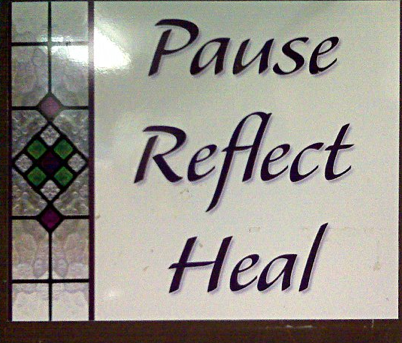
 “Patient Room Reminder”
Johnson City Medical Center, Johnson City, Tennessee

I cried unto the Lord with my voice, and he heard me out of his holy hill. Selah   
Psalm 3:4 King James Version

Richard Lischer’s new book, Stations of the Heart: Parting with a Son, describes the lived suffering and healing in a family and community of faith.  He invites all of us to be part of the conversation.  It is a conversation about crosses and the heart of the Christian faith.

The narrative by Richard Lischer is important because as Christians we are all part of the mystery of the story he tells of courage, hope and faith.  It is a unique story of a father’s love and loss.   It is a long story without short-cuts, easy answers or generalizations.  It is difficult lesson!

“Selah” is one of those ancient prescriptions that provides some direction.  It can be translated as “Pause, Reflect, Heal”.   It is a reminder to all who enter the suffering stories of our lives.  It is a beautiful word!

Thanks be to God for this awe-inspiring story of loss and the challenge of what it means to be a healing agent.  

Marvin


References:

Lischer, Richard (2013-04-02). Stations of the Heart: Parting with a Son Knopf Doubleday Publishing Group. Kindle Edition.


Saturday, March 23, 2013

The Poor

Poverty Map

Looking at his disciples, he said:
“Blessed are you who are poor,
    for yours is the kingdom of God."
Luke 6:20 (NIV)

For you know the grace of our Lord Jesus Christ, 
that though he was rich, yet for your sake he became poor, 
so that you through his poverty might become rich.
2 Corinthians 8:9 (NIV)

The naming of Pope Francis (3/13/13), a Jesuit from the global south, was a remarkable act with and because of his focus on the poor.  Could it be that the poor will be a “blessing” and a healing agent?   Could it be that the mission of the church to the poor will be a healing moment of a God who is at work in the world?  Will Pope Francis be a “healing agent”?

There is no question that the poor have generated concern and debate within and outside the church.  What seems missing in the conversation is whether or not we are “with the poor”.  Being present with them is the Christ-like response and His mandate.

For healthcare and specifically global healthcare, let us affirm that we are with them where God is at work.   Let us join with the church universal in being “where God lives”!  Let us pray for wisdom in how we respond in both our hearts and our acts as partners in the Kingdom of God.  Help us to see our poverty and become rich with the blessings of the poor.   

Marvin

References:


Debates about the Poor:
TED Talks - Hans Rosling & Esther Duflo
When Helping Hurts: How to Alleviate Poverty Without Hurting the Poor...and Yourself by Steve Corbett, Brian Fikkert

Selected Posts: 
4/23/12 - Rx - Ubuntu
1/23/11 - Peace from Above


Thursday, March 14, 2013

Restoration

“New Creations” Holland Farmers Market, Holland, Michigan
Therefore, if anyone is in Christ, the new creation has come: The old has gone, the new is here!   2 Corinthians 5:17 (NIV)

“Our Christian response to the questions of theodicy should not be to seek to find apologetic explanations, or to passively submit to suffering, but to join the protesting and suffering God in fighting to end human misery and injustice.   A theology of the cross is a theology of protest. We focus on the cross in the hope that one day there will be no more crosses.” by Derek Flood

Derek Flood in his book, “Healing the Gospel: A Radical Vision for Grace, Justice and the Cross”, makes the argument that healing is best understood in the nature of restoration.   He argues that this is the message of the New Testament and the message of Easter is when Christians acknowledge a cosmic restoration of God’s grace.  That is the basis of our Hope!

 “When will life be meaningful again?” is a common plea in response to the spiritual dislocation of illness.  When that time occurs, we can accurately state that restoration and healing have occurred.  Maybe a more accurate statement is that life takes on a new meaning and in some ways one that is “more meaning filled”.  

So God’s healing restoration is not just about returning to “life as it was”, but a new creation.  God’s act of grace on the cross changes everything for those who suffer.  We have a new identity by the unexpected and unmerited entry of God’s example in our lives.  

Have a blessed and healing Easter.

Marvin

References:
Flood, Derek (2012-08-06). Healing the Gospel: A Radical Vision for Grace, Justice, and the Cross (Kindle Locations 1953-1955). Cascade Books, an Imprint of Wipf and Stock Publishers. Kindle Edition. 

Previous Related Posts:


Friday, March 8, 2013

Seniors


"Young and Old", Tenwek, 2012

In the Last Days, God says, “I will pour out my Spirit on every kind of people: Your sons will prophesy, also your daughters; Your young men will see visions, your old men dream dreams.”     Acts 2:17 (NIV)


In the recent movie, “Quartet”, we are invited into the complicated stories of the lives of senior retired British opera singers.  There is one scene of a lecture by the protagonist, Reggie, about the nature of opera with the young who are visiting the retirement home.  It turns out to be a wonderful conversation.

Like the senior professional singers, how can we hear the stories of senior healthcare professionals?  One answer is that they require specific policies if they are to continue to practice.  It could be inferred that there is no specific utility or importance of these seniors in a culture of the newest and most advanced technology.   What the “Quartet” suggests is that their art lives on in profound ways because of the their stories and struggles.  A commentary about the lives of these seniors by the young physician for the retirement home in the “Quartet” reveals their contribution:  “Their love of life is infectious.  They inspire us.”

So instead of just seeing senior physicians as a “credentialing” issue, maybe our art and history can also inspire the young but it must be more than education.  I pray that our dreams will be fulfilled in the lives of the young as healing agents.  

Thanks be to God for all who practiced their art and their faith as service to God and his creation.

Marvin

References:

Porreco RP.  The senior obstetrician requesting obstetric privileges.  American Journal of Obstetrics & Gynecology.  206(3):183-6, 2012 Mar.
Related Posts:
Gift Reflections, 10/3/11
Healing Agent Education, 11/14/11
Techniques and Transformation, 2/1/12
Kingdom Learning, 2/25/12
Vocation & Retirement, 7/3/12
“Burnout” and a “Path Report” - 8/12/12
Residential Learning, 3/2/13


Saturday, March 2, 2013

Residential Learning


Guest House at Tenwek Hospital, 2012 

We start our empathy learning in our homes from those we love and who love us.  There is evidence that there are genetic components, but we get to practice these responses with assistance in our homes.

Medical education is primarily a “problem-based” approach and located within the academy.  Unfortunately, this approach is associated with decreasing empathy in the learners.  So how can we find an educational response that promotes empathy in the learner?

In a recent edition of Christian Century “Roommates and Friends” describes an innovation in seminary education.   A space, “Friendship House” was established to provide housing with ministry to and with the disabled.  It is a beautiful and innovative example of healing learning!

I have only experienced a few places that are similar residential learning environments.   One example is a mission station like Tenwek where students can live in community with those they serve.  This guest house is a intergenerational and interdisciplinary space.   These residential spaces are powerful environments to learn and share the wonderful and difficult stories of healing.  

Have you experienced innovative, creative, empathetic healing learning environments?  I would love to hear where you have learned those empathetic skills.

Marvin


References:
Neumann M et al Empathy decline and its reasons: a systematic review of studies with medical students and residents.  Academic Medicine.  86(8):996-1009, 2011 Aug

Related Posts: 
Pupils/Patients - Teacher/Doctor, 2/14/11
Gift Reflections, 10/3/11
Healing Agent Education, 11/14/11
Techniques and Transformation, 2/1/12
Kingdom Learning, 2/25/12